Lake Lanier boating safety: what Georgia law requires before you sail
The question parents ask me in the Aqualand Marina parking lot, usually while holding a small hand, is the simplest one there is: is this safe? Lake Lanier boating safety comes down to a short list of rules Georgia already wrote down, a boat that carries the right gear, and a captain who reads the sky before casting off. Here is what the law requires of every boat on this lake, and what I check before your sail.
Lake Lanier boating safety starts with Georgia life jacket law
Georgia law is specific about this. Every child under 13 has to wear a USCG-approved life jacket, meaning one carrying a U.S. Coast Guard label certifying it meets federal flotation standards, any time the boat is underway, and there has to be a wearable jacket on board sized for every person aboard, per the Georgia Department of Natural Resources boating regulations. Those rules apply to my sailboat exactly as they apply to a bass boat.
The part people miss is fit. A jacket rated for a heavier child rides up over the ears in the water and does nothing, so real Lake Lanier boating safety starts at the dock with sizing, not with the forecast. I keep child and youth sizes aboard and fit them at Dock Zk before we leave the slip. If your child already trusts a jacket at home, bring it, as long as it is USCG-approved and matches their weight.
Georgia also requires a throwable device on boats 16 feet and longer, a fire extinguisher on boats with an inboard engine or built-in fuel tank, a sound signal, and working lights after sunset. Those are the items a game warden checks first. Families sailing with small children can read more in our guide to sailing with kids on Lake Lanier.
Lake Lanier boating safety and Georgia's alcohol limit
Georgia treats boating under the influence, known as BUI, the same way it treats driving under the influence, with the same 0.08 blood alcohol threshold, and the Georgia DNR boating page spells out how officers enforce it. The same page covers the education rule: anyone born on or after January 1, 1998 needs a boater education certificate to run a motorized boat here. Neither one lands on you as a guest, because I am the operator. Guests who want to bring drinks should read our BYOB charter rules for Lake Lanier first.
Why Lake Lanier has a reputation for boating accidents
Because the record is real. The U.S. Army Corps of Engineers, which built Buford Dam and still manages the lake, has documented more boating fatalities here than on any other Corps reservoir in the country. That is a traffic number more than a water number.
Lanier sits about an hour up I-985 from Atlanta, so on a July Saturday you get every kind of boat on the same water at the same time: rental pontoons, wake boats, jet skis, bass boats, and a handful of sailboats. Add coves with standing timber left from before the lake filled, unlit docks, and crowds that stay out past dark, and the risk picture looks less like open water and more like an unmarked intersection. Lake Lanier boating safety, in practice, is about staying out of other people's way.
The volunteers at the Lake Lanier Association spend their season marking hazards and hauling debris out of the water, which tells you what floats around after a heavy rain. A sailboat under sail moves at walking speed, which takes most of the collision energy out of the day.
Lake Lanier boating safety gear: what my sailboat carries
Every charter leaves Aqualand Marina with the legal minimum aboard and then some: fitted life jackets for each guest, a throwable cushion, a fire extinguisher, a sound signal, running lights, a first aid kit, an anchor with rode, a boarding ladder, and a charged phone plus a handheld radio.
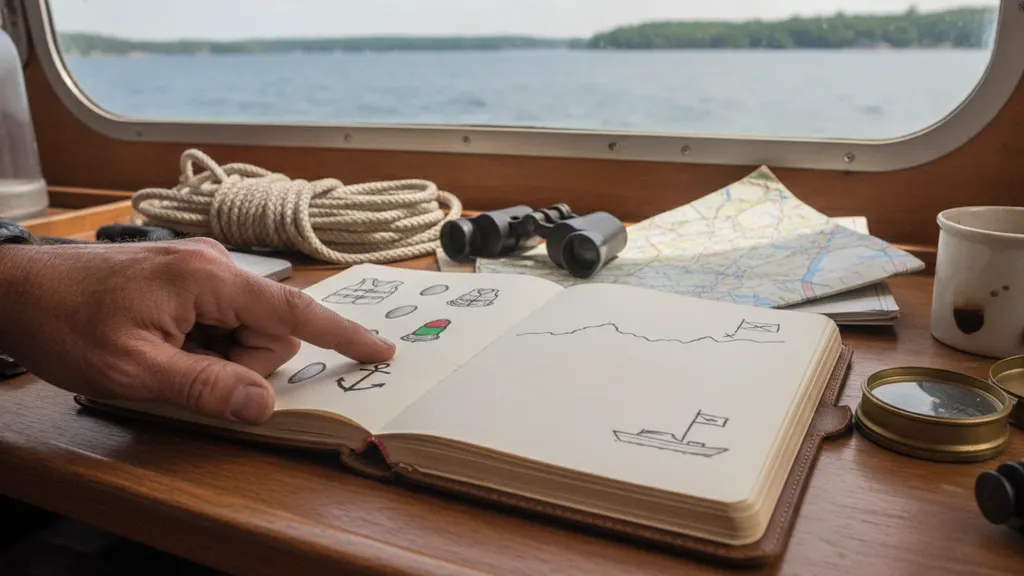
Gear is the easy half. The other half is the briefing you get before we cast off, which is where Lake Lanier boating safety actually lives: where the jackets are stowed, how to move around the boom, what to grab if the boat heels, and what happens if someone goes in the water. I earned my captain's license in 2006 at the American Sailing school based at Aqualand Marina, training under longtime instructor Captain Ed Tillman, and I still run guests through the same pre-sail sequence he taught me on my first day.
The jacket count is not a judgment call. Georgia ties it to heads on board, so the number rises with your group and a full boat carries a full set. Guests new to a sailboat can see what the rest of the day looks like in our guide to your first time on a sailboat.
How weather changes the Lake Lanier boating safety plan
Weather decides more sails than anything else on this lake. I read the forecast from the National Weather Service office in Peachtree City the night before and again the morning of, and I watch the radar trend while you are still driving up I-985.
North Georgia summer storms build fast and inland, often after lunch, and they arrive with wind before they arrive with rain. The rule I hold to comes straight from National Weather Service lightning safety guidance: once you hear thunder, there is no safe place on open water, and you wait 30 minutes after the last rumble. I learned that rule the hard way in my second season, when I let a building cloud line talk me into finishing a sunset sail instead of turning back early, and we motored into the marina through hard rain with soaked guests and a phone ruined by the spray before the first real thunder even hit. Nobody was hurt, but it was closer than I ever want to repeat, and it is why I now turn back at the first hardening of that cloud line instead of waiting to hear thunder. Lake Lanier boating safety in August usually means moving the sail earlier in the day rather than gambling on a gap between cells.
Wind behaves differently in different parts of the lake. The open water near Browns Bridge gives steadier breeze than the tight coves around Two Mile Creek, and the fetch below Buford Dam can stack up a short chop that feels bigger than it is. Our guide to Lake Lanier sailing weather goes deeper on what I watch.
| Condition | What it looks like | What happens to your sail |
|---|---|---|
| Storms in the afternoon forecast | Clouds building inland by early afternoon | We sail earlier or move your date |
| Thunder within earshot | Dark line upwind, radio chatter | We head in, then wait 30 minutes |
| Strong sustained wind | Whitecaps across the main channel | We reef down or stay in protected water |
| Almost no wind | Glassy water, limp flags | We motor to a cove and swim |
Lake Lanier boating safety habits guests can bring aboard
Most of what guests can do happens before you reach Dock Zk. Tell me who cannot swim, who is under 13, and who has a medical condition I should know about. Soft-soled shoes, sunscreen, water, and a hat do more for your day than anything I can hand you.
Wear the jacket if you are on the fence. The Coast Guard boating safety program runs National Safe Boating Week each May to push exactly that habit on inland lakes like this one, and adults who wear one all day set the tone for the kids watching them. Good Lake Lanier boating safety habits are boring by design: stay seated while we tack, keep hands off the lifelines, and ask before you move forward of the mast.
Pack light and pack soft. A hard cooler slides and glass breaks, which is why our packing list for a Lake Lanier sailing charter asks for soft bags. US Sailing publishes crew overboard drills worth reading if you sail often.
Frequently asked questions
Do kids have to wear life jackets on a boat in Georgia?
Yes. Georgia law requires every child under 13 to wear a USCG-approved life jacket whenever the boat is underway, and the Georgia DNR boating rules make no exception for a sailboat moving under sail or engine. On my charters, kids get fitted at the dock before we leave the slip, because a jacket sized for a bigger child rides up over the chin in the water and stops doing its job. I carry child and youth sizes aboard. You are welcome to bring a jacket your child already trusts, as long as it is USCG-approved and matches their weight range.
Is Lake Lanier as dangerous as people say?
The fatality record is real, and it is mostly a crowding story. The Corps of Engineers Mobile District, which operates Lake Lanier, runs water safety outreach at its ramps and parks for that reason. In 20 years out here, the close calls I have watched happen involved speed, alcohol, darkness, or all three, and a sailboat at walking pace with a captain who does not drink on the job sits outside that pattern. Lake Lanier boating safety is less about the water than about who else is on it and how fast they are going.
Do I need a boating license to be a guest on a charter?
No. Georgia has no boating license for passengers, and you do not need one to step aboard. The state education rule, described on the Georgia DNR boating pages, applies to people operating a motorized boat who were born on or after January 1, 1998. I am the operator on every charter, so that certificate is mine to hold, not yours. Lake Lanier boating safety is my job on the water, not a box you tick before you come aboard. Bring shoes you can move in and tell me if anyone in your group cannot swim.
What happens if a storm shows up while we are already out?
We head in. Thunderstorms on Lanier usually give some warning in the form of a hardening cloud line upwind, and the forecast products from NOAA and its National Weather Service offices are what I check before and during a sail. If thunder starts, the sail is over for at least 30 minutes past the last rumble, and we sit that out at the dock rather than on open water. If weather cuts a charter short, we talk about a new date. I would rather move your sail than test it.
Is a sailboat safer than a pontoon or a jet ski on a busy weekend?
Nothing on the water is risk free, but the physics help. A sailboat carries its weight low, moves at a walking pace, and has one person steering who is paid to pay attention. Rental pontoons and personal watercraft put inexperience and speed on the same water, which is why the Corps of Engineers record for this lake reads the way it does. Atlanta's official visitor bureau sends day-trippers up here all summer, so plan on company. Lake Lanier boating safety on a Saturday is mostly about being predictable: a slow boat holding a steady line is easy for everyone else to read and avoid.
What is the safest time of year to book a Lake Lanier sail?
Spring and fall, if you have the choice. Traffic thins out after Labor Day, the afternoon storm pattern eases, and the breeze gets steadier. Explore Georgia, the state tourism office, keeps Lanier on its list of lake destinations year round, and the quiet months are the ones I like for families. May deserves a note too, since the Coast Guard National Safe Boating Week lands then and the ramps fill with first-timers of the season. A weekday morning in September beats a July Saturday by a wide margin.