Lake Lanier sailing team building activities that actually work
The question I get most from offsite planners calling about a sail out of Aqualand Marina, Dock Zk, is whether Lake Lanier sailing team building activities produce anything real or just make for a boat ride with a slide deck afterward. Here is the honest answer: I have held a USCG Master 100-ton license since founding Lord Nelson Charters in 2005. The work on a sailboat is real, the jobs are visible, and a group sorts itself out inside the first half hour under sail.
Which Lake Lanier sailing team building activities help a crew work together?
The ones with a real job attached. Hoisting the main, trimming the jib through a tack, holding a compass course, setting and breaking out an anchor, and recovering a fender tossed over the side all give a group a shared task with instant feedback. No icebreaker required, and nobody has to pretend the exercise matters.
Those tasks are not party games. US Sailing's Basic Cruising certification, the entry-level standard for keelboats, boats with a fixed weighted fin underwater instead of a dinghy's swing board, defines competence against two stated conditions, daylight hours and moderate wind and sea, and four emergency and recovery procedures: VHF distress calling, response to a steering failure, anchoring, and recovery of a person or object overboard. The same standard lists four heavy-weather sail-handling skills beyond that baseline: reefing, changing a headsail, dropping sail, and rehoisting underway. On a four-hour corporate charter I run a trimmed-down version of that same sequence, covering most of the four emergency procedures in some form on almost every sail, without the written exam or the logbook sign-off a sailing school would require before certifying a student.
Tacking is the clearest drill I know. One person calls it, one steers, two handle sheets, and the boat tells you within five seconds whether the timing was right. A team that spent the morning arguing about process in a conference room sorts out hand-offs fast once the sails start flogging. For the planning that wraps around the sail, my corporate retreat Lake Lanier sailboat guide covers the rest of the offsite day. The Lake Lanier sailing team building activities that fail are the ones where the captain does all the work and the guests watch.
How a captain adapts Lake Lanier sailing team building activities for mixed experience
I assign jobs by comfort, not by seniority. A group of twelve usually has two confident sailors, several people who want to steer, and at least one guest who would rather sit in the shade with a cold drink and watch the shoreline go by. All three are fine, and all three have a role on the boat, which is the point of Lake Lanier sailing team building activities built around rotation instead of lectures.
Life jackets get fitted at the dock before we leave Dock Zk, sized by weight and chest following the US Coast Guard recreational boating safety guidance. Then the jobs go out.
| Job on board | What the guest does | Good fit for | Rotation length |
|---|---|---|---|
| Helm | Steers a course and calls the tack | Anyone who wants the hot seat, no experience needed | 15 to 20 minutes |
| Main trim | Eases and trims the mainsheet on a clear cue | Guests who like one job done well | 15 minutes |
| Jib trim | Releases one sheet and winches in the other through a tack | Guests happy to move and work a winch | 2 or 3 tacks |
| Lookout and traffic | Watches wake boats, buoys, and the Browns Bridge channel | Quiet observers and anyone staying seated | Open |
| Timekeeper | Times each tack and reads the results back to the group | Guests who would rather measure than pull | Open |
The point of the rotation is that no one gets stuck in the audience. Lake Lanier sailing team building activities should give the quietest person on the team something concrete to own, even if that is calling a wake boat off the starboard bow near Browns Bridge.
What trimming and steering teach a team
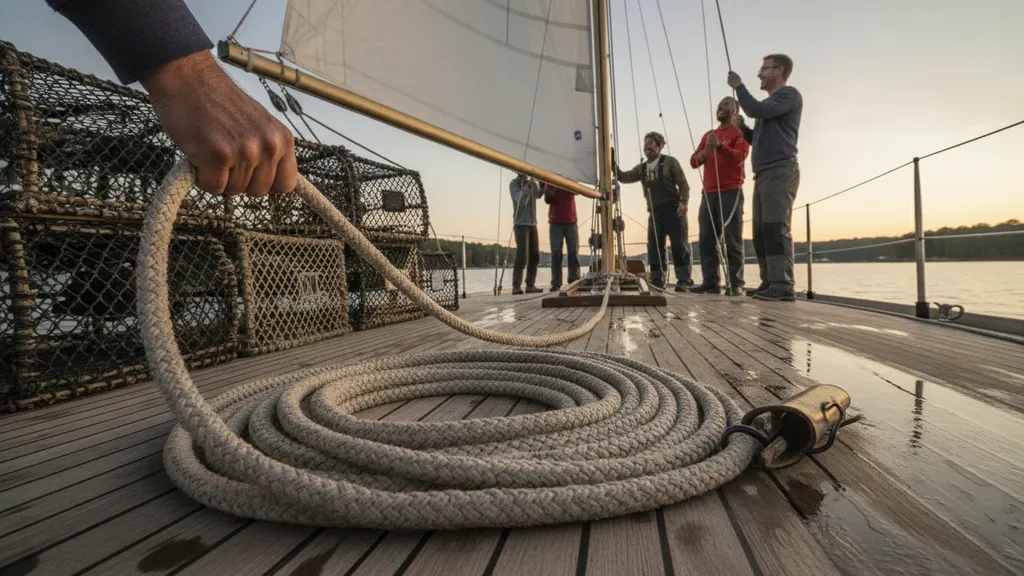
Trim is a feedback loop with a number attached. Ease the mainsheet too far and the boat slows; over-trim it and the boat heels without gaining speed. Steering teaches the opposite habit, looking well ahead instead of down at the bow. Both lessons travel back to the office better than any metaphor I could offer.
Sail shape settles arguments with evidence. When two guests disagree about how hard to sheet in, we try both and read the speed. American Sailing's keelboat coursework treats trim as a core skill for that reason: small adjustments, measured results. Guests who want more of it can read what a charter can actually teach in my piece on Lake Lanier sailing lessons.
Heavy air adds a second layer. US Sailing lists reefing, changing headsails, dropping sails, and rehoisting underway among the core heavy-weather skills, and while I will not take a corporate group out in conditions that call for all four, I do demonstrate a reef so the team can see what planning ahead looks like. The best Lake Lanier sailing team building activities borrow that habit: shorten sail before you need to, not after.
Balancing structure and downtime in Lake Lanier sailing team building activities
Two-thirds working, one-third open. That split has held up over 20-plus years of charters out of Aqualand Marina. Teams need the hands-on block so they have something to talk about, and they need the anchored hour in a quiet cove for the talking to actually happen.
On a four-hour sail that means roughly two hours of rotation, ninety minutes anchored or reaching under easy sail, and a half hour of structured debrief. A full day stretches both ends, with a swim stop and a longer run toward the islands. Explore Georgia's Lake Lanier recreation listings give planners a sense of the shoreline parks and coves worth building that open block around. Catering is its own problem, which I cover in Lake Lanier sailing charter food and drinks.
Resist the urge to fill the open block. Lake Lanier sailing team building activities earn their keep in the gaps, when the VP and the new hire end up on the same rail with nothing scheduled.
What companies should include in a post-charter team debrief
Hold it on the water, at anchor, before anyone smells the parking lot. Twenty minutes, three questions, one notetaker. Ask what the team did well under time pressure, where a hand-off broke down, and which habit from the boat is worth copying on Monday morning. Lake Lanier sailing team building activities earn their value in that one answer.
Name the moments specifically. "The third tack off Two Mile Creek" beats "the sailing part." Hand out the notetaker job before the sail starts so the notes actually exist. A shared vocabulary helps, and the terms used across US Sailing's education and training programs are a good source for it: skipper, crew, trim, lee helm (the boat's tendency to swing away from the wind when underpowered), lookout.
Then stop. Lake Lanier sailing team building activities do not need an action-item spreadsheet to have mattered, and the debrief loses the room if it runs past the second cold drink.
Planning the day: weather, water, and getting to Dock Zk
Book early, watch the forecast, and build in a weather window. Spring and fall give the steadiest breeze, summer gives afternoon thunderstorms, and a corporate group holding twelve calendars does not get to reschedule easily once the date is out. Lake Lanier sailing team building activities depend on that date holding more than they depend on any drill.
I check the National Weather Service forecast office in Peachtree City the morning of every sail, and I follow the National Weather Service lightning safety guidance: if thunderstorms are in range, we delay or move the date. I moved a twelve-person offsite for a logistics company in September 2019 with two hours' notice when a line of storms built faster than the morning forecast called for, and the group came back the following Friday instead. Nobody got a refund fight or a bad review out of it, but it cost me a full day of lost dock time I never billed for. Lake level matters too, since the US Army Corps of Engineers Mobile District manages releases at Buford Dam, and the Lake Lanier Association remains the best local source on conditions and shoreline use.
Getting here is simple: I-985 to Flowery Branch, then into Aqualand Marina and down to Dock Zk. The City of Flowery Branch publishes park and ramp information if part of your group wants to come by trailer. Lock the date before you lock the agenda; my Lake Lanier charter booking timeline explains how far ahead to reserve, and the Lake Lanier sailing weather forecast guide shows how I read wind and heat. Lake Lanier sailing team building activities live or die on that one logistics call.
Frequently asked questions
What do corporate teams actually do on a sailing charter?
They sail the boat. On a four-hour charter out of Aqualand Marina I split the group into helm, main trim, jib trim, and lookout, then rotate every 15 to 20 minutes so everyone handles the boat at least once. In between we tack repeatedly, set and recover an anchor, and run a fender overboard drill. Those tasks come from the keelboat standards published by US Sailing, which include anchoring, overboard rescue methods, and steering failure response. Lake Lanier sailing team building activities land because the feedback is immediate: a mistimed tack stalls the boat and the whole crew feels it.
Will people who have never sailed feel left out?
No, and the mixed group is the normal case. Nothing on the job list needs prior experience. Steering a compass course takes a minute of coaching, and trimming the jib is a matter of releasing one line and winching the other on a call. Guests who would rather not move get the lookout or timekeeper job and stay part of the day. American Sailing builds its entry-level keelboat training around the same assumption, that a complete beginner can handle real jobs on a small boat in one session with a captain aboard.
How long should a company offsite boat charter run?
A half day of four hours fits most teams of eight or fewer and leaves room for a full rotation plus an anchored hour. Groups of ten or twelve do better with a full day, because the rotation takes longer and so does lunch. Add drive time: the Atlanta Convention and Visitors Bureau lists Lake Lanier among the day-trip options from the city, and the run up I-985 to Flowery Branch takes most Atlanta offices under an hour outside rush hour. Build a 30-minute buffer at the dock so the sail does not start late.
Is sailing safe for a group with no experience?
Yes, with the usual conditions. Everyone is fitted for a life jacket at the dock, I brief the boom and the working lines before we leave the slip, and I keep the boat inside the envelope US Sailing describes for basic cruising: daylight hours, moderate wind and sea conditions. Georgia has its own rules on boating safety and registration, published by the Georgia DNR boating program, and as the captain I carry the required gear. If the forecast turns, we move the date rather than sail a group into weather nobody signed up for.
What time of year is best for a corporate sail on Lake Lanier?
April through early June and September into October. The breeze is steadier, the heat is manageable, and afternoon thunderstorms are less likely than in July and August. Summer sails still work if you start early or take a sunset slot. Winter can be beautiful and empty on the water, with layers required. Whatever month you pick, the National Weather Service lightning safety guidance drives the call: thunder means we are off the water, so a flexible date beats a fixed one for any group bigger than a handful.
Can we run a working session or debrief on the boat?
Yes, at anchor. Under sail the boat is loud and everyone has a job, so a real conversation does not happen. Anchored in a cove off Two Mile Creek with the engine off, a team of twelve can hear each other fine. I keep the debrief to about 20 minutes and hand out the notetaking job before we leave the dock. The Lake Lanier Association is a good source on the lake's coves and shoreline use if you want a quieter anchorage for a longer session. Laptops are a bad idea; paper works.