
Lake Lanier sailing weather forecast: read wind, heat, and rain
Almost every week out of Aqualand Marina, Dock Zk, someone asks me the same thing: does a 40 percent chance of rain mean we cancel? Usually not. A Lake Lanier sailing weather forecast is really four readings, wind, heat, sky, and timing, and they almost never go bad all at once. Read them in that order and you will choose better dates, pack lighter, and stop writing off afternoons that were going to be fine.
What a Lake Lanier sailing weather forecast should tell you
Four readings matter for a half-day sail: wind speed and direction, heat index, sun strength, and storm timing. A good hourly forecast gives you all four by the hour instead of one summary icon for the whole day, because a Saturday that looks bad at noon is often perfect at six.
I pull the hourly graph from the National Weather Service forecast office in Peachtree City, which covers north Georgia and this lake. The hourly view splits the day into blocks, so you can see that a 60 percent rain chance is really one hour at 3 p.m. and nothing on either side of it. Phone apps flatten that detail into a single cloud icon, and that is how perfectly good sailing days get written off three days early.
Read the forecast in the order the day will hit you. Wind decides whether we sail or motor. Heat decides how long anyone wants to stay out. Sun decides what you wear. Storms decide the start time. The same four questions drive a Lake Lanier sailing weather forecast weeks out, except at that range you are reading a seasonal pattern rather than a prediction, which is one reason an evening slot holds up better in July than a 2 p.m. departure.
| What to check | Where I look | What it changes |
|---|---|---|
| Wind speed and direction | NWS hourly graph | Sail plan and route |
| Heat index | NWS point forecast | Time of day, water you bring |
| UV Index | NOAA UV guidance | Sunscreen, hats, sleeves |
| Storm timing | Hourly chance and radar | Departure time, go or reschedule |
| Lake level and dam release | Army Corps of Engineers | Docking and anchoring stops |
There is a full breakdown of this topic in Lake Lanier sailing wildlife: birds, shorelines, and safe viewing.
How wind direction and speed change a Lake Lanier sailing weather forecast
Wind is the part of a Lake Lanier sailing weather forecast that decides whether you get a sail or a boat ride. Under about 4 knots the sails hang and we motor. Above the high teens the boat heels hard, spray starts, and guests stop relaxing. The middle is where a charter day lives.
Direction matters as much as speed here. Lanier is a flooded river valley with wooded ridges on both sides, so wind bends around points and dies in the lee of a shoreline. A steady southerly fills the open water between Browns Bridge and the Flowery Branch arm. A northerly coming down off Buford Dam tends to be gustier and shiftier in the narrows. When the forecast calls a direction that funnels well, I plan a longer run out and a quieter return.
Gust spread is the number most guests skip. A forecast of 8 knots gusting 20 is a different afternoon from a steady 12, even though the averages look close. The American Sailing wind and seamanship resources explain the Beaufort scale that captains still use to describe that range in plain language, and U.S. Coast Guard recreational boating safety guidance sits behind most go or no-go calls on this lake. If you have never sailed, the first-timer's guide covers what heeling actually feels like.
Heat, humidity, and UV in a Lake Lanier sailing weather forecast
Georgia humidity is why the heat side of a Lake Lanier sailing weather forecast deserves its own look: a 92 degree afternoon at high humidity routinely reads past 100 on the heat index, and that ten-plus degree gap is what actually plans the day. The National Weather Service explains that heat index combines air temperature and relative humidity to describe what a body actually feels, and out on open water that number sets the pace of the afternoon.
The bands matter more than the raw degrees. National Weather Service heat index guidance starts its caution range at 80 degrees F and climbs through extreme caution and danger from there. On the boat that translates into simple choices: a July charter at the top of the caution band runs better at 9 a.m. or after 6 p.m. than it does at two in the afternoon, and I will say so when you ask about a date.
Sun is the other half. NOAA UV Index guidance gives you a daily number for exposure risk, and the UV line of this forecast is the one guests underestimate most, because the water throws light back up at you under a hat brim. Long sleeves in light fabric beat bare arms by hour three. Our dress guide for charters goes through what actually works on deck.
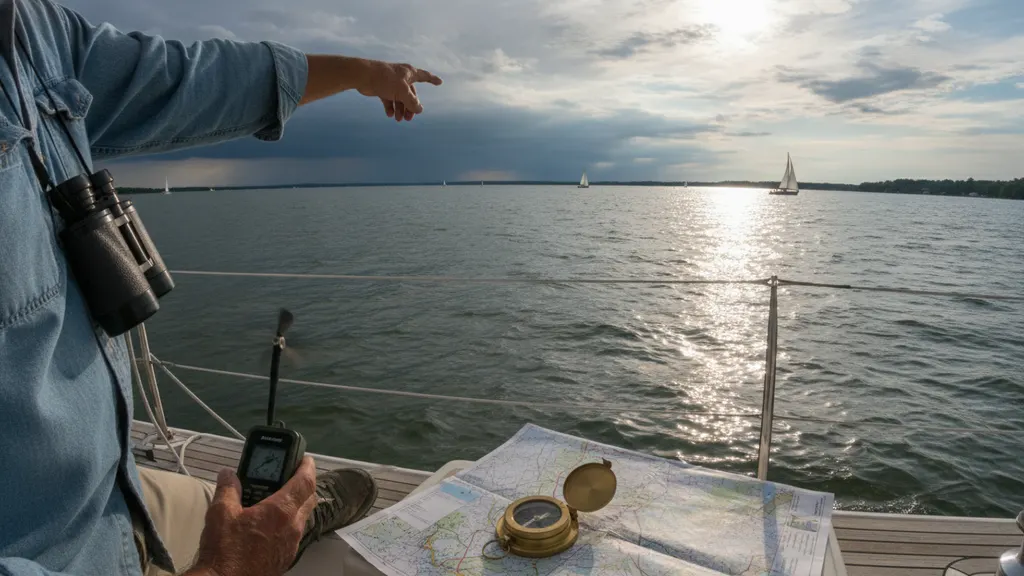
Reading rain and thunderstorm timing in a Lake Lanier sailing weather forecast
A rain percentage is a probability for an area over a period, not a verdict on your four hours. The part of a Lake Lanier sailing weather forecast that matters here is timing and type, because a 2 p.m. pop-up cell that clears by five is nothing like a frontal line arriving at six.
North Georgia summers run on heat-driven convection. Cells build inland through the afternoon, drop hard for twenty minutes, and move on. Frontal systems behave differently: the wind shifts ahead of them, the sky goes uniformly grey, and the whole afternoon is gone. Reading the storm section of this forecast means asking which of those two you are looking at, then checking whether the hourly chance clusters in one block or smears across the day.
Lightning ends the conversation. National Weather Service thunderstorm forecast and warning information is the source I follow, and the rule on the water is simple: if thunder is audible, we are headed in. A sailboat mast is the tallest thing for a quarter mile. More on how that call gets made in when captains delay a charter.
I misjudged that call once. On July 19, 2026, the forecast showed a clean afternoon until a cell built fast over Cumming and put us back at the dock forty minutes into what should have been a three-hour charter. Nobody got hurt and the guests were gracious about it, but I would rather cut a sail short early than explain afterward why we stayed out.
What to ask the captain before departure
Ask three things the night before: what the wind is doing inside our window, whether storm timing has moved, and what to bring for the heat. I read the Lake Lanier sailing weather forecast every morning at 6 a.m., nine seasons into running Lord Nelson Charters out of Aqualand Marina as a licensed captain, so the answer is already sitting in my head when you call or email.
Ask about the lake too, not only the sky. The U.S. Army Corps of Engineers operates Buford Dam, and release schedules change current and water level in ways that affect docking and where we can anchor for a swim stop more than they affect the sail itself. Our guide to water levels and dam releases gets into the detail.
Last, ask about the drive. Weather that looks fine at Aqualand Marina can be a wall of rain on I-985 an hour earlier, and the opposite happens just as often. If you are coming up from Atlanta and the radar looks ugly over the city, call me before you turn around. The lake is frequently clear while the Perimeter is soaked.
Frequently asked questions
How does a Lake Lanier sailing weather forecast define too much wind for a charter?
There is no single cutoff, but a comfortable private charter usually sits between about 4 and 16 knots, which is Beaufort Force 2 through 4. Below that the sails go soft and we motor. Above it the boat heels hard, spray comes over the rail, and guests who came for a calm afternoon stop enjoying it. Gust spread matters more than the average: 8 knots gusting 22 rides rougher than a steady 14. US Sailing publishes the seamanship and safety standards that describe how conditions scale from easy to demanding. I make the final call the morning of your sail.
Does a 40 percent chance of rain mean my sail gets cancelled?
Usually not. That number is the chance of measurable rain somewhere in the forecast area during a period, not a promise of rain on your boat for four hours. I look at the hourly breakdown in the Lake Lanier sailing weather forecast and at radar trends the morning of the sail. Rain by itself is survivable and sometimes pleasant. Lightning is the stopper. National Weather Service lightning safety guidance is blunt about it: when thunder roars, go indoors, and that goes double on open water under a tall metal mast. We delay, shorten, or reschedule.
What does the heat index mean for a day on a sailboat?
Heat index is air temperature adjusted for relative humidity, the National Weather Service way of describing what a body actually feels. In Georgia a 92 degree afternoon at high humidity can land well past 100 on the heat index chart, and there is no shade in open water unless we rig some. On the boat it changes practical things: how much water you bring, whether we sail morning or evening, and how long anyone wants to sit in direct sun. National Weather Service forecast pages publish the hourly numbers for our area, and I read them before every charter.
Does the weather change what safety gear we carry on board?
The gear list barely changes, because the boat carries what Georgia law requires on every trip, including wearable life jackets for everyone aboard. What weather changes is how we use it. In building wind or with a storm moving in, I ask guests to put jackets on before conditions get worse rather than after. The Georgia Department of Natural Resources Wildlife Resources Division publishes the state boating rules behind that baseline. Heat pushes the list the other direction: more water, hats, and a shade plan matter more than extra equipment on a 95 degree Saturday.
Does heavy rain change the lake itself?
Yes, in ways you notice after a storm rather than during one. Runoff from north Georgia creeks pushes sediment and debris into the upper lake, so water near feeder creeks can run muddy for days and floating limbs turn up in the main channel. The Lake Lanier Association tracks lake conditions and shoreline cleanup work and is worth a read before you plan a swim stop. Heavy rain upstream also changes how much water the Corps of Engineers moves through Buford Dam, which affects levels and current more than it affects your sail.
Do I need sunscreen for a two hour sunset sail?
Yes, for the first hour at least. The sun angle drops through the evening, but exposure before about 6 p.m. in a Georgia summer is still meaningful, and open water reflects light back at you from underneath. NOAA UV Index guidance is the simple way to judge daily sun exposure risk: anything at 6 or above counts as high. I check it alongside the rest of the Lake Lanier sailing weather forecast and keep sunscreen aboard, though bringing your own is smarter. A hat and sunglasses do more for comfort than most guests expect.