
Lake Lanier sailing wildlife: birds, shorelines, and safe viewing
Last April a couple from Decatur asked me, twenty minutes out of Aqualand Marina, whether the big dark bird on the dead pine was an eagle. It was. That single moment is why Lake Lanier sailing wildlife has become one of the most common requests I get on a half-day charter. The short answer: yes, you will see herons, ospreys, and often eagles, and a sailboat is the quietest way to do it.
What guests see on a Lake Lanier sailing wildlife trip
Great blue herons, ospreys, double-crested cormorants, Canada geese, and bald eagles make up most of what you will see from the deck. Add turtles on deadfall, the occasional deer swimming a narrow cove, and in late summer swallows working insects just above the water.
Great blue herons are the bird most people notice first. They stand in the shallows at the back of coves between Flowery Branch and Browns Bridge, and they hold still long enough for a phone photo as long as the boat is moving slowly and nobody shouts. Ospreys are easier to find in the air than on a perch, usually working over open water in the middle of the day. Double-crested cormorants raft up in loose groups and dive for long stretches, which makes guests give up trying to count them.
Bald eagles are the sighting people remember, and the lake holds enough resident pairs that most guests see one if we have forty minutes for a shoreline leg. They tend to reuse the same dead pines and snags year after year, so after fourteen years of sailing out of Aqualand Marina I can point to five or six trees between Flowery Branch and Browns Bridge before we even leave the dock. The Georgia Wildlife Resources Division explains that bald eagles and their nests carry legal protection under state and federal rules, so a nest tree is not a destination to steer toward, even when the bird sits in plain view from open water. I point it out, slow the boat, hold a straight line past the tree, and let the wind carry us by at a distance instead of circling back for a second look.
What makes a sailboat good for this is the quiet. Under sail with the engine off there is no engine noise and very little wake, so birds that would lift off well ahead of a powerboat often stay where they are. That quiet is also the practical reason Lake Lanier sailing wildlife viewing works better under sail than under power, and it is why I plan the slow legs of a charter along the shoreline instead of across open water. If you are still deciding on a boat type, I compare the options in my guide to a private charter versus a boat rental.
Where Lake Lanier sailing wildlife viewing fits in a charter route
Wildlife viewing is not a separate trip. It is a 30 to 45 minute leg inside a normal charter, usually at the start or the end, when I run the boat slowly along a shoreline instead of reaching across the middle of the lake. The rest of the sail stays the same.
We leave from Aqualand Marina, Dock Zk, in Flowery Branch, just off I-985, and the protected coves start within the first mile out of the channel. The lake's shoreline is managed by the U.S. Army Corps of Engineers, which limits development along most of the bank specifically to protect water quality and habitat, and those undeveloped stretches are where the birds concentrate. The Flowery Branch lakefront parks sit on the same water, so some of the best heron shallows are a short sail from the dock rather than a long motor away. A Lake Lanier sailing wildlife leg here means ten minutes of beating out past the marina breakwater, then a long, slow reach past three or four coves before the birds even register that a boat is nearby.
| Charter length | Viewing window it opens | Shoreline leg I use |
|---|---|---|
| Half day, morning | Herons feeding in the shallows before the lake gets busy | Coves south of Aqualand Marina toward Flowery Branch |
| Half day, afternoon | Ospreys hunting over open water, turtles on deadfall | Out toward Browns Bridge, then back into a cove |
| Full day | Two slow shoreline legs with a swim stop between them | North toward Two Mile Creek and back |
| Sunset sail | Birds returning to roost, low light on the bank | Short hop out, long drift home |
Guests who want both scenery and birds usually do best on a full day, because it leaves room for two slow shoreline legs with a swim stop in between. My write-up of Lake Lanier sailing routes lists the islands and shores I use, and the best Lake Lanier sailing wildlife viewing happens along those same stretches of water.
How close should a charter boat get to birds and shoreline nests?
Far enough that nothing changes behavior. If a heron straightens up, a cormorant dives and does not resurface near you, or an eagle shifts its weight on the branch, you have crossed the line already. What I mean by a nest buffer is the minimum distance a boat holds from an active nest tree so the adult birds keep behaving normally, feeding, resting, and not watching the water instead of the sky. The rule I give every guest for Lake Lanier sailing wildlife viewing is simple. Hold a steady, predictable line past the animal and let the distance do the work, rather than aiming the bow straight at it to get a better look. A boat that behaves predictably reads as part of the shoreline, and one that changes course and speed reads as a threat, which is what pushes a bird off a perch it might not use again that day.
Two distances do most of the work. Federal bald eagle management guidelines recommend keeping activity at least 330 feet from an active nest, and Georgia boating rules call for idle speed within 100 feet of shorelines, docks, and anchored boats. The U.S. Coast Guard Office of Boating Safety makes the same basic point about wake and speed near shore: slow down early, and hold a predictable course so nothing has to react to you.
Habitat matters as much as the bird. Shallow bank, standing deadfall, and overhanging limbs are the nursery for everything you came to see, and the Lake Lanier Association documents how much of the lake's health depends on protecting that watershed and shoreline. So I do not put the bow into the brush for a better angle, and I do not run a shoreline at speed.
Seasonal patterns behind Lake Lanier sailing wildlife sightings
Winter is the best bird season and the hardest weather season. Leaves are down, eagles are on nests, and ducks and loons are on the water. Summer gives the most comfortable sailing and the fewest midday sightings, so you shift the viewing leg to early morning or the hour before sunset.
Wind and heat drive the day more than the calendar does. I read the forecast from the National Weather Service office in Peachtree City the night before every charter, and a front moving through changes a plan faster than any season ever does. Cold months need layers and a shorter plan, which I cover in my guide to winter sailing on Lake Lanier. Water level matters just as much as weather. What locals call winter pool is the lower lake level the Army Corps holds through the cold months to make room for spring rain, and it exposes more flat ground and stump field along the banks, which is exactly where wading birds go to feed. I check both the wind forecast and the current lake level before I confirm any Lake Lanier sailing wildlife charter, the same way I check them for any other sail, and I walk through that process in my post on reading the Lake Lanier forecast.
Protecting the lake while taking wildlife photos
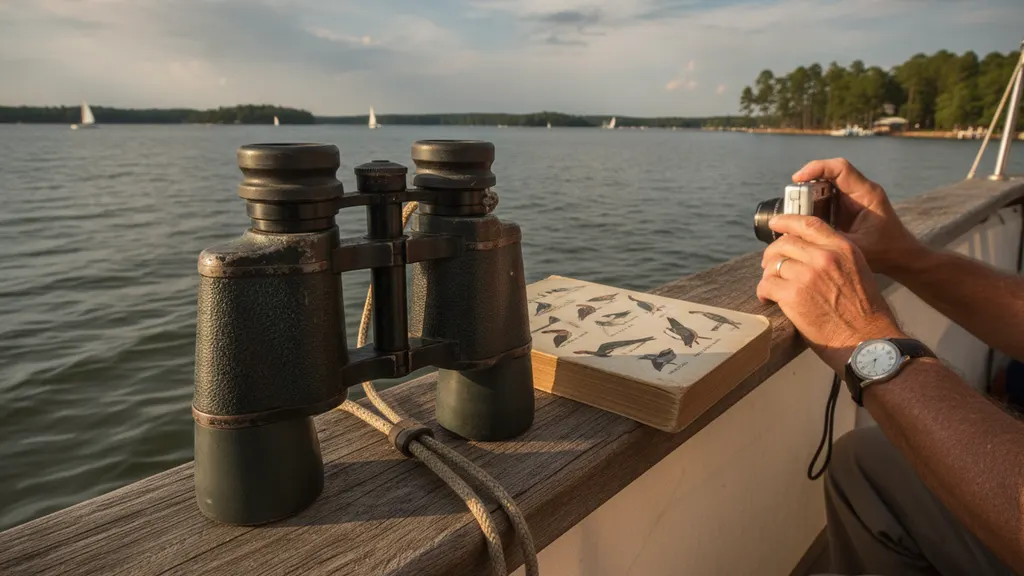
Use zoom, not closed distance. A phone at 3x from 200 feet away gets a worse photo than a cheap pair of binoculars held in front of the lens, and neither one moves the bird. Keep voices low, keep hands inside the rail, and take nothing off the shoreline.
Three habits cover most of it. Do not feed anything, do not leave fishing line or food wrappers loose on deck where the wind can take them, and do not ask the captain to push closer for a shot. Sailing quietly is a skill in itself, built on reading wind shifts early enough that the boat never needs a sudden correction near the bank. If photos are the point of your day, my Lake Lanier photography charter guide covers light, timing, and gear. Guests often ask whether photographing a nest is allowed at all, and the answer is that watching and shooting from a distance is fine every time. What is not fine is flushing a bird, which just means forcing it off a perch or out of the water before it is ready to move, usually by circling, aiming the bow straight at it, or closing distance for a better shot. I plan every shoreline leg so the answer stays the same whether a ranger happens to be watching or not, because that is the only version of Lake Lanier sailing wildlife viewing worth offering guests.
Frequently asked questions
What birds will we actually see on a sailing charter?
On most half-day sails out of Aqualand Marina you will see great blue herons in the shallows, ospreys over open water, double-crested cormorants in loose rafts, and Canada geese almost everywhere. Bald eagles show up on a good share of winter and early spring trips, usually perched on a dead pine rather than in flight. Turtles on deadfall and the odd swimming deer round it out. Explore Georgia's Lake Lanier overview is a reasonable starting point for what the lake and its shoreline look like before you arrive.
Are there bald eagles on Lake Lanier, and can we get close to a nest?
Yes, there are resident bald eagles, and no, we do not approach a nest. The Georgia Wildlife Resources Division explains that bald eagles and their nests are protected under both state and federal law, and federal bald eagle management guidelines recommend keeping activity at least 330 feet from an active nest. I learned to respect that number the hard way. In my second season running charters, I held what I thought was a generous distance off a nest tree near Browns Bridge, and a gust pushed the boat sideways into that buffer before I could correct, close enough that the adult bird left the branch. Nothing happened to it, but I did not like watching it go, and I have planned every eagle sighting with extra room ever since. You will still get a good look through binoculars, and the bird will still be there next month.
When is the best time of year for Lake Lanier sailing wildlife viewing?
December through March is the strongest stretch for birds. Bare trees make perched raptors easy to pick out, eagles are on nests, and waterfowl are wintering on the lake. The trade-off is cold air and a shorter sailing window. May through September gives easier weather but pushes sightings into the first two hours after sunrise and the last two before sunset. I read the National Weather Service forecast before recommending a date, since a 15 knot north wind in January changes the plan more than the season does.
Is a sailboat better than a powerboat for watching wildlife?
For viewing, yes. Under sail there is no engine noise and almost no wake, so you can hold 100 feet off a shoreline without pushing water into it or flushing whatever is standing there. A powerboat at idle is louder at the same distance. The trade is coverage: we move slower, so a Lake Lanier sailing wildlife plan covers less shoreline in a day. US Sailing publishes safety and boat-handling material if you want to understand what the boat is doing while you watch.
Can we bring kids on a wildlife-watching sail?
Yes, and kids usually spot things first. Two practical notes: Georgia law requires children under 13 to wear a life jacket while the boat is underway, and young kids lose patience on a long slow shoreline leg, so I keep that leg to about 30 minutes and break it up with a swim stop. The U.S. Coast Guard Office of Boating Safety has clear guidance on fit and sizing for children's life jackets. Binoculars a child can hold with one hand help more than any camera.
What should I bring for a Lake Lanier sailing wildlife trip?
Binoculars first, then a hat, polarized sunglasses, sunscreen, and a soft-sided bag. Leave the drone at home. If you shoot with a camera, bring the longest lens you own and shoot from a seated position, because the deck moves. Pack out everything you bring, including fishing line, which the Lake Lanier Association flags as part of the shoreline debris problem it works on. Soft-soled shoes are required on deck, and a light layer matters even in July once the sun drops behind the ridge.