
Does Lake Lanier make you seasick? What sailors need to know
Last week a guest emailed me the night before her charter and asked plainly, "will I get sick?" She lives in Alpharetta, has never been on a sailboat, and worried an afternoon on the water would ruin her anniversary. Anxiety about seasickness Lake Lanier sailing trips is common, and the honest answer is that Lake Lanier behaves nothing like the ocean. In twenty years working out of Aqualand Marina I have watched maybe three guests get really queasy, and each one made it home smiling.
The table below puts the two environments side by side. Wave period is the factor most guests do not expect: the time between one wave crest and the next. Open-ocean swells recur every 6 to 10 seconds, long enough for the inner ear to detect sustained pitch and roll and trigger nausea. Lake Lanier's fetch-limited chop cycles every 1 to 2 seconds at wave heights that rarely cross 24 inches even on the windiest afternoons, leaving the vestibular system little reason to fire a distress signal. That physical difference is why guests who have felt sick on cruise ships and offshore fishing boats almost never report trouble on a Lake Lanier charter.
| Factor | Lake Lanier | Open-Ocean Charter |
|---|---|---|
| Typical wave height | 12-18 in (calm); up to ~24 in on gusty days | 48-96 in (4-8 ft rolling swells) |
| Longest open-water fetch | Under 6 miles (USACE data) | 100+ miles (open ocean or coastal shelf) |
| Dominant swell period | 1-2 seconds (short-fetch chop) | 6-10 seconds (sustained rolling) |
| Charter-season avg wind | 8-14 mph (NWS, N. Georgia) | 10-25 mph (coastal average, varies by region) |
| First-time guest sick incident rate | Rare; roughly 3 guests in Captain Rice's 20-year career at Aqualand Marina | Higher; sustained swell period triggers prolonged vestibular-ocular mismatch |
How Lake Lanier compares to open ocean sailing motion
Answer first: the water on Lake Lanier is calm compared to any coastal charter, and the reason is fetch. Fetch is the distance wind travels over open water without hitting land, and short fetch cannot build tall waves. On Lake Lanier the longest fetch stays under 6 miles per U.S. Army Corps of Engineers reservoir survey data.
Ocean charter guests may see 4 to 8 foot rolling swells before the day is out. On Lake Lanier the typical afternoon chop reaches 12 to 18 inches, and gusty summer days may push it to about 2 feet in the widest bay stretches near Browns Bridge. That is a scale of motion your inner ear registers as gentle rocking, not the pitching swell that triggers ocean seasickness.
For guests coming from an ocean context, this matters. Motion sickness triggers when your visual field and inner ear disagree for a sustained period. Lake Lanier's short-fetch chop rarely sustains that mismatch long enough to produce symptoms. Reducing seasickness Lake Lanier sailing risk starts with knowing the water is not what you fear. If you want a deeper look at what a Lanier day feels like on the water, our post on Lake Lanier sailing weather breaks down what I watch on the forecast.
Weather patterns that shape seasickness Lake Lanier sailing risk
Answer first: the two conditions that produce real boat motion on Lake Lanier are afternoon thunderstorm gust fronts and post-storm confused chop. Neither is common on a well-planned charter because I watch the forecast and reschedule when the sky looks wrong.
Prevailing wind speed over the lake averages 8 to 14 mph during peak sailing months per National Weather Service data for north Georgia. That range produces the pleasant heel angle a sailboat is designed for and a light rocking motion. It does not produce the sustained wallowing that causes offshore seasickness.
Summer afternoons are a different matter. The Lake Lanier Association notes that thunderstorms develop rapidly over the reservoir from June through August, and as a USCG-licensed Master of Vessels I monitor NOAA forecasts continuously. When the marine forecast turns, I move departure earlier or push a booking to the next window. Guests worried about seasickness Lake Lanier sailing conditions should trust the captain's judgment on timing. A morning departure at 9 am with a return by 1 pm sidesteps the storm-cell hours almost every summer day.
Fall and spring are the calmest months. Cool air, stable pressure, steady winds, and low storm risk mean the boat rocks less. If motion sickness is your worry, book April, May, October, or early November. Our guide to the best time to sail Lake Lanier matches month to conditions.
Remedies to pack for your seasickness Lake Lanier sailing charter
Answer first: take an over-the-counter motion pill 60 minutes before you board, bring ginger candies as a backup, and keep water on hand. Most first-time guests who follow those three steps forget they were nervous by the time we cast off from Dock Zk.
Meclizine, sold as Bonine or Dramamine Less Drowsy, is the workhorse. It lasts 24 hours, does not knock you out the way older Dramamine does, and reliably prevents symptoms at Lake Lanier motion levels. Talk to your pharmacist about your other medications; the drug is safe for most adults but has interactions worth checking.
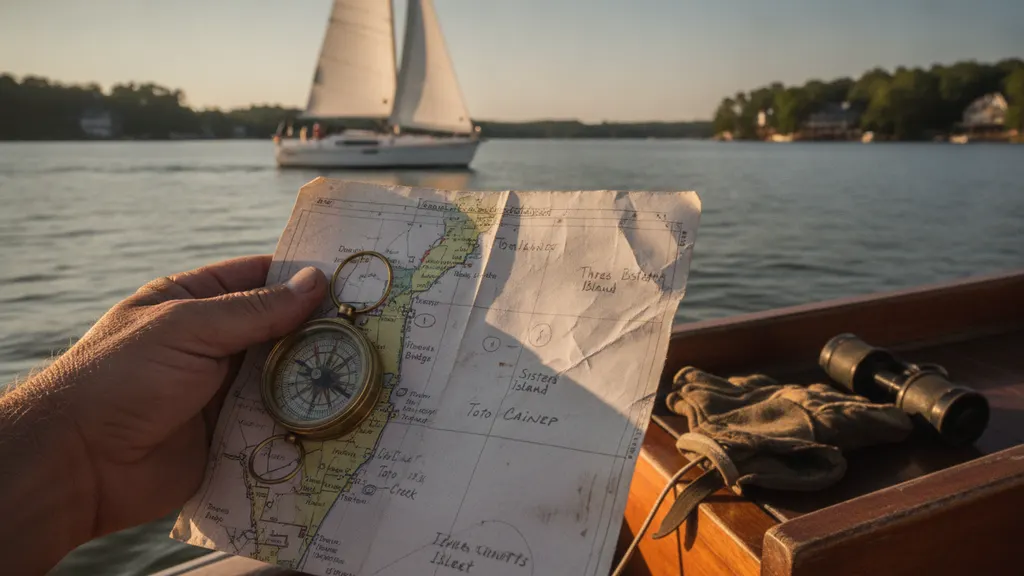
Natural options work too. Ginger chews or ginger tea have decent evidence behind them for mild motion sickness. Acupressure wristbands (Sea-Bands) help some guests and do nothing for others; they cost about $10 and are worth trying if you avoid medication. Sailing safety guidance from US Sailing recommends layering prevention: pill plus ginger plus hydration beats any single measure.
What does not work: alcohol, heavy caffeine, dehydration, or "toughing it out." Those combine to produce the exact conditions that make people feel worse and turn a good day into a rough one. For a fuller pre-charter prep list, see what to bring on a sailing charter.
Where to sit onboard to reduce seasickness Lake Lanier sailing symptoms
Answer first: sit in the cockpit, mid-boat, facing forward, with your eyes on the horizon. That single choice reduces perceived motion more than any pill does. Sailing instructors and vestibular research both place the cabin as the highest-motion position on a monohull and the bow as second; mid-cockpit passengers experience roughly a third of the vertical displacement.
Motion sickness is worst where the boat moves the most. On my sailboat that means the bow (the pointy front end) during any chop, and below-decks inside the cabin. The bow rises and falls with each wave, and the cabin removes your visual reference to the horizon, which is what your inner ear needs to stay synced with what your eyes see. Guidance from American Sailing matches what I have watched for twenty years: mid-boat cockpit position, eyes up, wins every time. This is the single biggest factor in seasickness Lake Lanier sailing outcomes.
What guests get wrong: reading a phone below-decks. If you feel a hint of queasiness, put the phone down, stand up in the cockpit if you can, look at Two Mile Creek or Buford Dam or whatever landmark is on the horizon, and breathe through your nose for two minutes. Symptoms usually pass in under five minutes on Lake Lanier because the underlying motion is so light.
What to eat before boarding at Aqualand Marina
Answer first: a light protein-forward breakfast about 90 minutes before boarding, skip the fried and greasy, easy on the coffee, and drink water on the drive up I-985 from Atlanta or Flowery Branch. Motion-sickness research published in Aviation, Space, and Environmental Medicine confirms that a light pre-exposure meal delays symptom onset compared to an empty stomach or a heavy, high-fat meal.
Good pre-sail breakfasts: scrambled eggs with toast, plain yogurt with a banana, oatmeal with berries, or a peanut butter sandwich. Ordinary food, ordinary portions. The goal is to have something in your stomach that steadies blood sugar without sitting heavy while you sail.
Skip: sausage biscuits, greasy diner platters, three cups of coffee, mimosas on the drive, empty stomach. Any one of those raises the odds of an unpleasant morning on the water. Boating safety guidance from U.S. Coast Guard boating safety reinforces this: alcohol on the water is the single strongest amplifier of every motion problem. Save the drinks for the ride home. The preparation is that simple on the food side. For a broader charter-day prep list, see what to wear sailing Lake Lanier.
Frequently asked questions
Is seasickness Lake Lanier sailing risk lower than on an ocean charter?
For seasickness Lake Lanier sailing purposes, no, and it is not close. Ocean sailing routinely produces 3 to 8 foot rolling swells every 6 to 10 seconds, which is the pattern that causes classic seasickness. On Lake Lanier the typical afternoon chop runs 12 to 18 inches per U.S. Army Corps of Engineers reservoir data, and the longest open-water fetch on the lake is under 6 miles. Wave energy stays low. Guests who have felt sick on cruise ships and offshore fishing boats almost never feel sick on my charter, and twenty years of first-time sailors have confirmed that pattern for me. The vestibular mismatch that causes nausea requires sustained, long-period motion to accumulate; Lake Lanier's short-fetch chop resets that cycle before it has a chance to build.
Which pill prevents seasickness Lake Lanier sailing guests most often need?
Meclizine, sold as Bonine or Dramamine Less Drowsy Formula, is what I recommend to nervous guests. It lasts 24 hours from a single dose, does not cause the heavy drowsiness of original Dramamine, and reliably prevents symptoms at the motion levels Lake Lanier produces. Take it 60 minutes before you board so it has time to work. Standard sailor prep guidance from US Sailing agrees. Talk to your pharmacist if you take blood pressure medication or antidepressants; there are interactions to check. Scopolamine patches exist for extreme cases but are overkill for the seasickness Lake Lanier sailing playbook I give first-time guests.
Can I still feel motion sick if the weather is calm?
You can, but it is rare and short-lived. Some guests are sensitive enough that even the gentle rocking of an anchored sailboat during lunch triggers mild queasiness. The remedy is almost always the same: come up on deck if you went below, look at the horizon (Buford Dam or the tree line makes a good visual anchor), sip water, and give it five minutes. National Weather Service marine forecasts at 8 mph winds usually mean glassy conditions, and even then a susceptible passenger can feel a hint of motion. Meclizine solves nearly all of it. Cutting seasickness Lake Lanier sailing worry is that manageable.
Are kids more likely to get seasick than adults?
Children ages 2 to 12 are somewhat more susceptible to motion sickness than adults on average, but Lake Lanier's calm profile keeps the risk low. The pediatric-friendly options are chewable Bonine for kids over 12, or the smaller-dose children's formulation for younger kids (check with your pediatrician on dosing). Keep kids in the cockpit, not below-decks, and have them help spot birds or wildlife along the shoreline. Distraction plus fresh air handles most cases without medication. For a family-specific run-through, see our Lake Lanier sailing charter for families guide.
Does drinking alcohol on the boat make seasickness worse?
Yes, badly. For seasickness Lake Lanier sailing prep the alcohol rule matters most. Alcohol impairs your inner ear balance signal, dehydrates you, and combines with sun and mild motion to make even a strong stomach queasy. Guidance from U.S. Coast Guard boating safety lists alcohol as the single strongest amplifier of on-water discomfort. Guests bring beer or wine for a sunset toast and that is welcome, but I recommend water and light snacks during the active sailing portion. If motion sickness is on your mind, skip alcohol entirely until you are back at Aqualand Marina, Dock Zk.
Should I cancel my charter if the forecast looks windy?
No, let me make that call. Twenty years of watching Lake Lanier weather has taught me the difference between a forecast that looks worse than it will feel on the water and one that actually warrants rescheduling. I check NOAA marine forecasts and radar the morning of every charter. If wind or storms cross a safety threshold I contact you directly to move the sail. You do not lose your booking and you do not sail in unsafe conditions. That arrangement is why I have never had a guest feel unsafe on the boat.