
Lake Lanier charter checklist: safety gear and comfort to pack
The question I hear most, usually from somebody already off I-985 and twenty minutes from Aqualand Marina, is some version of: do we need to bring life jackets? No. They live aboard the boat. The rest of a sensible Lake Lanier charter checklist is shorter than people expect: layers for wind, soft-soled shoes, water, sunscreen, and a bag that will not roll off a cockpit bench.
What the Lake Lanier charter checklist already covers aboard
Start by crossing items off. Safety gear is the boat's responsibility, not yours. I hold a U.S. Coast Guard Master's license, learned to sail on Lake Lanier as a teenager more than twenty years ago, and have run Lord Nelson Charters out of Aqualand Marina for the last eleven years, so this list comes from real trips rather than a manufacturer's insert card. The U.S. Coast Guard recreational boating safety program sets what a vessel carries, and one wearable life jacket per person aboard is the baseline. On a private sail out of Aqualand Marina, that gear is already stowed in the cockpit lockers.
What stays aboard covers the regulatory side: wearable life jackets sized for everyone booked, a throwable cushion, a fire extinguisher, a sound signal, an anchor with rode, and running lights for sunset sails. US Sailing's safety recommendations for crews go past the legal minimum on things like a first aid kit and a float plan, and I keep those aboard too.
Children are where the rules tighten. The Georgia Wildlife Resources Division boating rules require children under 13 to wear a flotation device while aboard a moving vessel, with narrow exceptions. You still do not need to buy one: tell me ages and weights at booking so the right sizes are in the locker. Our guide to what Georgia law requires before you sail has the fuller picture.
So the front half of this packing list is really just what you get to skip: flotation, signaling gear, anchor, first aid, and the boat's paperwork.
Headcount drives the one number that matters most on the boat's side of the list.
Sun, wind, and temperature: what to pack for Lake Lanier weather
Pack for cooler and windier than the marina parking lot. Open water between Flowery Branch and Browns Bridge has nothing to block the breeze, so a warm afternoon turns chilly once the sun drops behind the tree line. Layers you can shed and re-add beat one heavy coat every time.
I misjudged this exact problem on my own boat three summers ago. A group booked a 6 pm sunset sail in August, when Atlanta's afternoon high had been pushing 95 degrees, and I did not say a word about layers because the forecast looked like a lock for warm weather. By the final half hour, with the sun behind the tree line near Browns Bridge and ten knots of true wind turning into fifteen knots of apparent wind across the deck, three of the six guests aboard were cold enough to ask for the one spare jacket I keep in the cockpit locker. Air temperature that evening had dropped about 12 degrees between boarding and the dock, and apparent wind chill did the rest. I have mentioned the evening-layer line on every booking since, warm forecast or not, because a Lake Lanier charter checklist that skips the two-temperature problem is a checklist written by someone who has not actually been out there at 7:45 pm in October.
Bring sunglasses with a retainer cord, a hat that will survive real wind, a long-sleeve layer, and a light windbreaker. Check conditions the morning of your sail with the National Weather Service Peachtree City office, which covers north Georgia, and read the heat and ultraviolet pages from NOAA's heat safety resources in July and August. Our post on reading wind, heat, and rain on the lake explains what I look at before a trip.
Water temperature lags air temperature in spring and fall, and dam operations change the lake's level and current through the year. The U.S. Army Corps of Engineers, which operates Buford Dam, publishes the lake data I watch. That matters for a Lake Lanier charter checklist in two small ways: cooler spray than you expect, and a dock that may sit higher or lower than it did on your last visit.
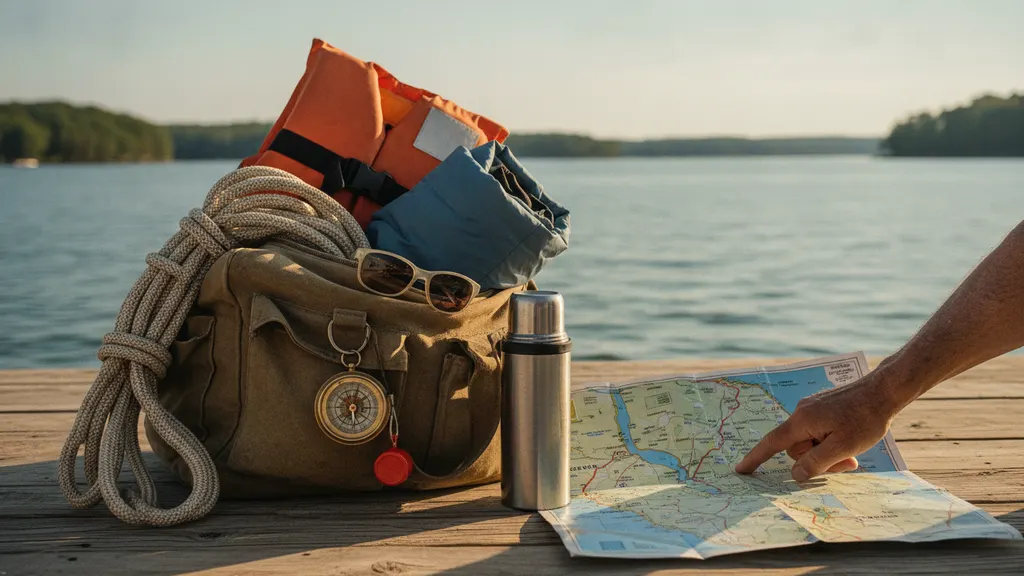
Footwear and bags on the Lake Lanier charter checklist
Soft, light-colored soles and closed toes. That is the whole shoe rule. Black soles leave marks on a white deck, heels sink into non-skid and into your ankles when the boat heels, and flip-flops come off at the worst moment. Boat shoes or clean sneakers are fine.
Bags are the other thing guests get wrong. A sailboat cockpit has lockers and benches, not a luggage hold, so one soft collapsible bag per guest is the sweet spot: 1 bag each, nothing with wheels or a rigid frame. A dry bag or zip bag for phones and keys earns its place, since spray comes over the rail on a good beat. American Sailing's crew clothing and gear basics covers the same ground for students, and our first-timer's guide to a sailing charter walks through the rest of the aboard routine.
One more line people forget when they pack for a Lake Lanier sail: a small towel. Lake water, a dropped drink, or a wet bench all get solved by a towel the size of a hand cloth.
Food, drinks, and personal items to confirm before you drive up
Confirm the edible part of your plan before you leave home, not at the dock. A private charter has no galley service, so what you carry on is what you have. Water first, in a soft cooler, more than you think you need, especially on a summer afternoon.
Heat is the real summer risk out here, and NOAA's heat pages linked above are the plain-language version worth reading before a July sail. Favor cans, pouches, or cups over glass, which breaks in a cockpit and ends a trip. Alcohol is legal aboard for adults, but Georgia treats boating under the influence as seriously as driving, and I am the one driving.
Personal items round out the Lake Lanier charter checklist: medications, an inhaler, motion-sickness tablets taken before boarding rather than after (our post on whether Lake Lanier makes you seasick explains the timing), a phone battery pack, and a cake if you are marking a birthday. Families should read the parent planning guide before packing for small children. Trash goes home with us: the Lake Lanier Association has spent years pulling debris off these shorelines, and a charter should not add to it.
What the Lake Lanier charter checklist says to leave at home
Short list, firmly held. Hard-sided coolers, glass bottles, black-soled shoes, heels, confetti, glitter, balloons, and loud speakers all stay in the car. None of it is about being precious; each one either marks the deck, breaks underfoot, or ends up in the water, where volunteer cleanups fish it out later.
Two more surprise people. Umbrellas have no place on a sailboat with a boom swinging over the cockpit, and drones are a distraction I would rather not share the airspace with. The last item on my Lake Lanier charter checklist is luggage volume: if a group arrives with more bags than people, something gets left on the dock.
The whole Lake Lanier charter checklist in one table
Here it is in one place, split by who is responsible. Print it, screenshot it, or forward it to whoever packs for your group. The middle column is my job. The right column is yours, and it takes about ten minutes to handle the night before, alongside the lake trip pages at Explore Georgia.
| Category | Already aboard | What you bring |
|---|---|---|
| Flotation | Wearable life jackets for every guest, throwable cushion | Nothing; just send ages and sizes at booking |
| Boat safety gear | Fire extinguisher, sound signal, running lights, first aid kit, anchor | Nothing |
| Sun and wind | Shade under sail and at the dock | Hat, sunglasses with retainer, sunscreen, long sleeve, windbreaker, long pants |
| Footwear and bags | Cockpit lockers and bench space | Soft-soled closed shoes, one soft bag, dry bag, small towel |
| Food and personal | Cooler space on request | Water, snacks, medications, phone battery, trash bag |
The split below shows how the 22 line items in that table land across four categories.
Frequently asked questions
Do I need to bring my own life jacket on a Lake Lanier charter?
No. Wearable flotation for every seat is already aboard, because the U.S. Coast Guard boating safety program expects one wearable life jacket for each person on a recreational vessel, and supplying that is the boat's job rather than the guest's. What helps me is knowing your headcount early, plus the ages and rough sizes of any children, so the right sizes are stowed before you walk down Dock Zk at Aqualand Marina. If you own a jacket you trust and prefer wearing it, bring it; the Lake Lanier charter checklist does not ask for one.
What should kids wear on a sailboat on Lake Lanier?
Dress children for sun and water, then plan on flotation. The Georgia Wildlife Resources Division requires children under 13 to wear a flotation device aboard a moving vessel, with limited exceptions, so pick clothes that layer over a jacket rather than fight it. A rash guard or long-sleeve sun shirt, a hat with a chin strap, closed-toe shoes, and one full change of clothes in a zip bag covers most of a half-day sail. Snacks that do not melt and a water bottle per child handle the rest.
What shoes are best for a sailing charter?
Closed-toe shoes with soft, light-colored, non-marking soles. Deck shoes and clean sneakers both work; black soles mark the deck, heels punch into non-skid, and sandals leave your toes exposed to cleats and hardware. American Sailing's guidance for new crew makes the same point for students stepping aboard a keelboat for the first time. If you plan to swim at anchor, pack the sandals in your bag and change into them on the swim step rather than wearing them while the boat is sailing.
Can we bring our own food and drinks aboard?
Yes, and most groups do. A private sail has no galley service, so plan a soft cooler with water first, then food that survives warm air and a little motion. Skip glass. Pack out everything you pack in; the Lake Lanier Association runs shoreline cleanups every year and a charter has no business adding to that pile. Alcohol is allowed for adults, in moderation, with the understanding that I am the one operating the boat. Cakes and catering trays are fine if you tell me in advance, so the Lake Lanier charter checklist includes cooler space.
What should I wear if Atlanta is hot but we are sailing at sunset?
Bring a layer you will not need until the last hour. Once the sun drops behind the tree line, apparent wind over open water makes the cockpit feel much cooler than the drive up from the city did. A long-sleeve shirt, a light windbreaker, and long pants in the bag cover it. Check the day's forecast with the National Weather Service office that morning, and treat an evening Lake Lanier charter checklist as a two-temperature packing problem rather than one.
What happens to my packing plan if a thunderstorm is in the forecast?
Packing does not change much; the schedule might. North Georgia afternoons build storms quickly in summer, and NOAA lightning and storm safety education is blunt about open water being the wrong place to wait one out. I watch radar in the hours before a sail and will move a start time or reschedule rather than take a group out under a building cell. Pack a light rain shell, keep phones in a zip bag, and expect a call from me if the timing needs to shift.