Lake Lanier eco charter: enjoy the lake and protect its water
I have sailed out of Aqualand Marina, Dock Zk, since the early 2000s, and the water I cast off into each November is the same water metro Atlanta drinks. Guests ask whether a sail day is really lighter on the lake than a rented powerboat day. A Lake Lanier eco charter is, and for specific reasons: wind does most of the pushing, every scrap of trash stays aboard, and the Clean, Drain, Dry steps Georgia asks of boaters take five minutes at the dock.
What responsible boating looks like on a Lake Lanier eco charter
Responsible boating here is mostly about three things: keeping everything you brought aboard, keeping your wake and noise away from shorelines, and keeping your hull and gear from moving organisms between lakes. None of it requires special equipment. It requires a captain who plans the day around those limits instead of around speed.
Responsible boating starts with who owns the water. The U.S. Army Corps of Engineers Mobile District, which operates Buford Dam, sets the rules for the lake and its shoreline, and the Corps also moves water for flood control and downstream supply. Levels shift through the year, which is why a cove that was deep in June can put a keel near a hump in November. I plan around published levels, and our guide to Lake Lanier water levels and boating covers how releases change plans.
The safety side lands in the same place. The U.S. Coast Guard Office of Boating Safety publishes the gear and behavior standards every recreational boat is held to, and a quiet boat with life jackets fitted at the dock is also a boat that is not dropping cushions, cans, and hats into the water at speed. Low impact and low drama are usually the same choice.
How can guests reduce trash and fuel impact on a Lake Lanier eco charter?
Three habits cover most of it, which matters on a lake with roughly 692 miles of shoreline to protect, per the U.S. Army Corps of Engineers. Bring less single-use packaging, hand every wrapper to a closed bin instead of a cup holder, and let the sails carry the day so the engine runs only leaving and returning to the slip.
The NOAA Marine Debris Program is blunt about the first part: dumping garbage overboard is illegal in U.S. waters, and the practical answer is to secure trash onboard until you are back at the dock. On a sailboat that is simple. A lidded bin in the cockpit, a second container below for cans and bottles, and nothing loose on deck when the breeze fills in.
Scale is the part guests rarely picture. That shoreline total is several times the roughly 100 miles of coast Explore Georgia describes on the state's Atlantic side, and every cove along it is somebody's water catchment and somebody's heron perch. A Lake Lanier eco charter treats those edges as the sensitive part of the day.
What should groups know about aquatic nuisance species?
Hitchhikers move between lakes on wet gear, not on their own. Zebra mussels, hydrilla fragments, and other aquatic nuisance species ride in bilge water, on anchor lines, in live wells, and on paddleboard fins. The practice Georgia asks for is three words long and takes less time than loading a cooler.
The Georgia Wildlife Resources Division promotes Clean, Drain, and Dry to keep those species from spreading. Clean means removing plants, mud, and debris from anything that touched the water. Drain means emptying water from the boat, the cooler, and any gear that holds it. Dry means letting equipment sit until it is fully dry, not damp in a bag in the trunk.
Guests matter here more than they expect, because my boat stays on Lake Lanier and their gear does not. Wakeboards, waders, inflatable floats, and a dog towel that visited another lake last weekend are the real risk on a Lake Lanier eco charter. Rinse and dry all of it at home. If your group plans to swim, our Lake Lanier swim charter guide covers gear in more detail.
How a Lake Lanier eco charter supports cleaner water and wildlife habitat
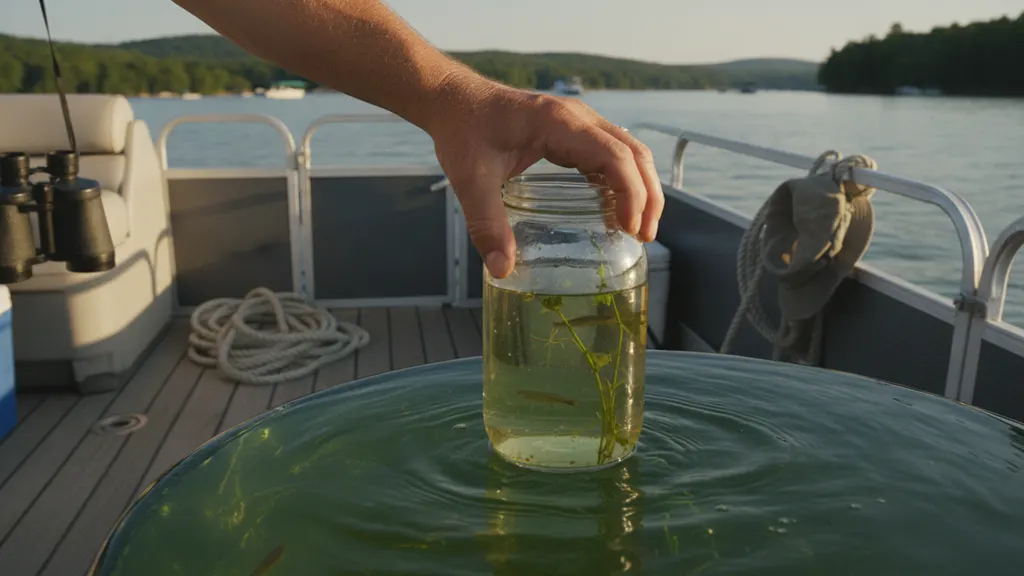
Mostly by being small, slow, and local on a watershed where the math favors caution: about 1,040 square miles of land drain toward Buford Dam, against roughly 59 square miles of lake surface at full pool. One boat, one captain, a handful of guests, and a footprint closer to a long walk than a drive.
A Lake Lanier eco charter borrows its priorities from people who watch this water year round. The Lake Lanier Association publishes lake stewardship and water-quality information, including shoreline cleanups and bacteria sampling that tells boaters what the water near populated coves is actually doing. Their material makes clear that the lake's problems are mostly runoff, trash, and sediment.
Runoff is the point I keep returning to, because the lake is the smallest part of its own watershed. Every parking lot and bare construction slope in that basin eventually reports to this water, carrying sediment and bacteria toward the coves where boats anchor and where great blue herons, osprey, and cormorants nest and feed. That is why the small things a crew controls are still worth doing: keeping trash aboard, running the engine less, and giving nesting shorelines a wide berth. On the water, the respectful move is to watch wildlife from a distance with the engine off rather than idling in close for a better look. Our Lake Lanier sailing wildlife guide covers the birds and the viewing distances in more detail.
Comparing a Lake Lanier eco charter with a rented boat day
A rental puts an unfamiliar driver behind an engine for four hours straight. A private sail puts someone who has worked this lake since the early 2000s on the helm with the engine mostly off, though a windless afternoon means more motoring than I would plan for. Low impact still comes built into how a sailing charter moves, even on a slow day.
| Day on the water | Main power source | Trash handling | Wake and shoreline effect |
|---|---|---|---|
| Private sailing charter | Wind, engine for docking | Closed bins, carried off at Dock Zk | Small wake, no beaching |
| Rented powerboat | Gasoline engine all day | Left to each renter | Repeated wake near coves |
| Personal watercraft | Gasoline engine all day | Little onboard storage | Close-to-shore running and noise |
Sailing is also a skill day, which changes how guests treat the water. Anyone who takes a turn at the helm learns why wind angle matters, and those basics match what the American Sailing Association teaches in its entry-level courses. If you are weighing the two, we compared them in Lake Lanier private charter vs boat rental, where the fuel dock shows up only as a formality.
What habits should every Lake Lanier eco charter guest follow at the dock?
Five minutes at the dock does most of the work. Walk the boat for trash, check under the cushions, hand wet gear back to its owner with a reminder to dry it, and look at the water around the slip before you leave.
- Walk the cockpit and cabin for loose trash before you step off at Dock Zk.
- Empty cooler water into the dock drain rather than over the side.
- Take home everything you brought, including fishing line and tackle packaging.
- Rinse and dry boards, floats, and shoes at home, not in a bag in the trunk.
- Report a fuel sheen, a dumped load, or a tangled bird to the marina office so it reaches the right agency.
Weather drives the rest. I check the National Weather Service forecast office in Peachtree City before every trip, because a charter moved by one afternoon beats a group throwing gear around a pitching cockpit. Our Lake Lanier charter checklist lists what to pack so less of it ends up disposable. That is what keeps a Lake Lanier eco charter low-impact: a schedule built around weather, not around a brochure promise.
Frequently asked questions
Is a sailing charter really easier on the lake than renting a powerboat?
In the ways you can measure, yes. Wind supplies most of the propulsion, so engine hours shrink to leaving and returning to the slip, and one captained boat replaces several rentals for the same group. The reservoir is operated by the U.S. Army Corps of Engineers as a water supply and flood control project rather than a playground, so fuel, trash, and sediment are shared problems. The honest tradeoff is speed: on a dead-calm afternoon I motor longer than I would like, and a six-hour booking can turn into five hours of sailing and one spent waiting on wind. A Lake Lanier eco charter has fewer chances to go wrong, not a guarantee of a fast one.
What happens to our trash during the trip?
It stays aboard and leaves with me. NOAA states that dumping garbage overboard is illegal in U.S. waters and recommends securing trash onboard until you can dispose of it ashore. On my boat that means a lidded bin in the cockpit, a second container below for cans and bottles, and a walk-through before anyone steps off at Dock Zk. Guests help most by handing wrappers straight to the bin instead of wedging them into a cup holder where the first good gust takes them.
Do guests need to do anything for Clean, Drain, Dry?
Yes, and most of it happens at home. The Georgia Wildlife Resources Division asks boaters to clean plants and mud off gear, drain water from anything that holds it, and dry equipment before it touches another body of water. My boat never leaves Lake Lanier, so the real risk is the wakeboard, float, waders, or dog towel that visited a different lake last weekend. Rinse those and let them dry fully before your trip, and tell me at the dock if something arrived damp.
Can we still swim and anchor in quiet coves?
Yes. Swimming from the boat is one of the lower-impact things a group can do, and anchoring is fine when it happens over open water rather than against vegetation or a nesting bank. I pick stops with depth and a sand or mud bottom, keep the engine off while guests are in the water, and never beach the hull. Public access points and park shorelines around Flowery Branch are managed for this kind of use, which is a good reason to use them.
How does the forecast change a low-impact plan?
It changes the route more than the rules. I check the National Weather Service before each trip for wind, storms, and heat, then pick a course that lets us sail instead of motor. Light air near Flowery Branch sometimes means a short motor out past the points to find breeze, and afternoon storms mean an earlier turn back toward Aqualand Marina. Moving a charter rather than pushing into weather also keeps gear out of the water, which is why a Lake Lanier eco charter is a planned charter.
We are driving up from Atlanta. Does that matter?
It is the biggest part of the footprint for most groups, which is why I suggest carpooling. The drive up I-985 to Flowery Branch takes most Atlanta visitors around an hour depending on traffic, and Atlanta's visitor bureau keeps trip planning information that helps you time it around rush hour. Two full cars instead of five half-empty ones does more for the day than anything that happens on the water. Park once at Aqualand Marina, walk down to Dock Zk, and the rest of a Lake Lanier eco charter runs on wind.